Leading Strategic Change with Intercultural Agility

I recently had the privilege of sitting down with George Kesselaar to explore his groundbreaking research on change management. What sets George’s work apart is that it is not only academically rigorous, but also deeply practical, and most importantly, interculturally agile. His approach is designed to resonate across cultures, address the complexity of human behavior, and meet organizations where they truly are. Our conversation revealed something urgent: if we do not reshape how we lead change to match the intercultural realities of today’s world, we risk building transformation strategies that look good on paper but fail to live in people’s hearts and minds.
Change is no longer a project. It is the new normal. And in that constant churn, we need better ways to help people understand, embrace, and sustain what change is asking of them. We need to stop assuming that systems will carry us through and start asking, “How are people experiencing this?”
That is where Intercultural Agility comes in.
The Invisible Layer of Change
George’s research and years of fieldwork have led him to focus not just on what needs to change, but how people relate to change. And it is in this space, emotional, relational, and often unseen, where many transformation efforts begin to fray.
"My work has been mainly focused on how we can support individuals that need to go through a change journey… whether that’s at a personal level, or within organizations that are very prone to not being able to change." — George Kesselaar
It is easy to focus on rollout plans, process maps, and communication cascades. But none of those address what happens when someone sits in a meeting, hears about a new initiative, and quietly thinks, “This doesn't make sense for me.” Or worse, “This doesn’t feel safe.”
Those internal reactions are shaped by culture: how people make sense of authority, how they experience time, how they decide what is right, and how they navigate uncertainty. If we don’t take culture seriously, we end up with strategies that miss the very people they’re meant to serve.
Listening Differently
One of the most striking things George said in our conversation had nothing to do with frameworks or models. It was about presence.
He described moments when a client team, stuck in the grind of rollout and resistance, was introduced to Intercultural Agility for the first time.
“Suddenly, the room goes quieter. People start listening differently. They begin asking each other deeper questions.” — George Kesselaar
That shift, from managing change to listening within it, is where the real work begins.
You Can’t Roll Out Culture
We have worked with many organizations where cultural change was treated as something to be “rolled out.” There was a handbook, a new set of values, a rebranded culture code. But in George’s words, and in our shared experience:
"You can’t roll out culture. You have to create it together."
Culture is not imposed. It is built through conversation, through tension, through alignment, and through behaviors that are seen, felt, and reinforced over time. Especially in diverse teams, culture must be co-created.
This is what we refer to at KnowledgeWorkx as the Third Cultural Space, a new, shared environment that emerges when people from different backgrounds come together, not to compromise, but to create something that works for all of them.
It is in this space that trust is built, assumptions are surfaced, and new ways of working are born.
Behavior as the Bridge
One of the cornerstones of George’s approach is the idea that behavior is the bridge between culture and change.
You cannot change culture by wishing it into being. Nor can you hope that new behaviors will emerge without first understanding what drives them. That is why we rely on structured intercultural tools that help teams see what is otherwise invisible.
At KnowledgeWorkx, these tools, like the Three Colors of Worldview and the 12 Dimensions of Culture, give language to people’s instincts and preferences. They help answer questions like:
Why does one team see directness as clarity, while another sees it as confrontation?Why does one leader feel urgency, while another waits for consensus?
These frameworks reveal how values such as honor, fear, guilt, individuality, time, or community shape our experience of change. And once we understand those patterns, we can design environments where change feels less like an imposition and more like an invitation.
Teams That Can Carry Change
In the end, no strategy, no matter how brilliant, will succeed if the people delivering it cannot work together across their differences. That is why change needs teams that are interculturally agile, not just technically competent.
George’s research confirms what we have seen time and again. When Intercultural Agility becomes part of the team’s DNA, change not only accelerates, it deepens.
“When people feel heard, they stop resisting.” — George Kesselaar
In these moments, change becomes something that is not just survived, but something that is owned.
Change is Inevitable. Resonance is a Choice.
There is no shortage of organizations trying to move fast. But speed without resonance leads to short-lived success.
Real transformation requires a different posture. It asks us to pause, to see, and to engage the cultural landscape we are operating in. We have a guide explaining how worldviews become consequential across three moments of planned change where this posture makes a difference in developing change-supportive behaviour (CSB). Identical change strategies produce divergent executive engagement depending on worldview alignment. These moments are demonstrated in the following process model:

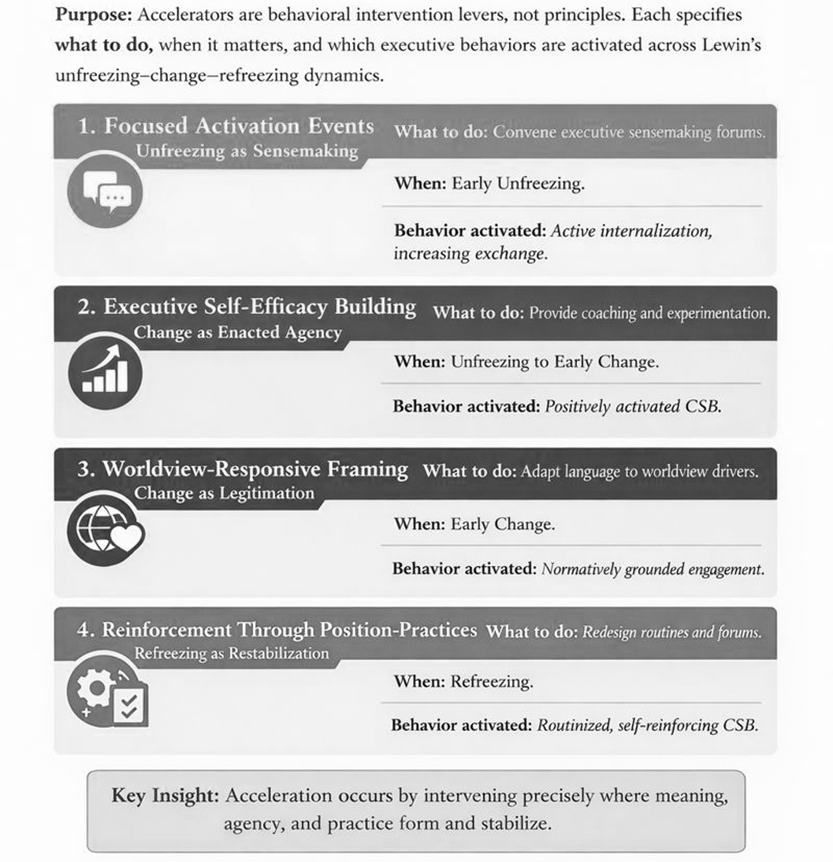
To make things practical, culturally agile change agents can apply four accelerators to traditional change models (such as Lewin’s Three Stages) to support success:
“Intercultural Agility created positive disruption every time we applied it. It helped people see differently, align better, and move forward faster.”— Marco Blankenburgh
Change, done interculturally, may feel slower in the beginning. But it builds the relational infrastructure that allows you to go faster and further with the people who matter most.
Make Culture Your Change Advantage
You may already be deep into a change journey, or you may be standing on the edge of one. Either way, the question is not whether you have a strategy. The real question is whether your people are ready to live into that strategy together.
At KnowledgeWorkx, we have seen what happens when Intercultural Agility is not an add-on but a foundation. We have seen resistance turn into ownership. We have seen disengagement shift into dialogue. And we have seen fragile transformations grow into something strong, lasting, and shared.
Culture is not the soft side of change. It is the core of it. And when you choose to make culture your advantage, you invite people to shape the future with you.
If you are ready to design a change journey that is strategic, sustainable, and interculturally agile, we would be honored to walk with you.
Over the last 20 years, KnowledgeWorkx has developed solutions that are global, locally relevant, holistic, and practical. Our innovative approach delivers more accurate analysis, which results in integrated and more effective solutions. Our solutions create a progressive and natural connection between national, personal, team, and organizational culture.

This work is licensed under a Creative Commons Attribution-NonCommercial-NoDerivatives 4.0 International License.