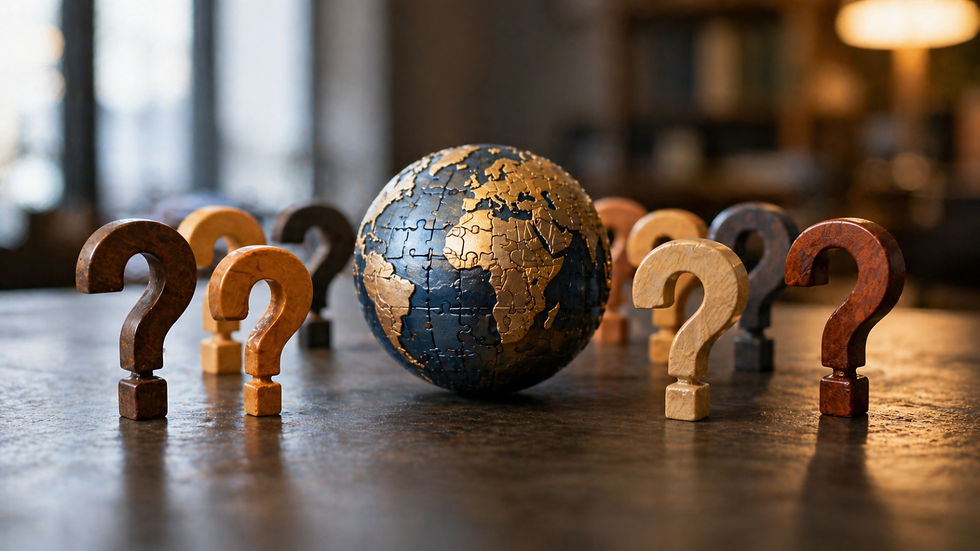
The Skill Behind the Skills of the Future
- Mar 18
- 6 min read
Updated: Apr 10
Why the World Economic Forum’s Top Skills Only Flourish in a Third Cultural Space

The World Economic Forum Future of Jobs Report 2025 identifies the skills that organizations increasingly need in the coming years. These are widely discussed as the capabilities required for the future of work. Yet there is a deeper question leaders rarely ask.
What allows these skills to actually come alive inside a team?

Organizations often respond to reports like this by launching training programs. Analytical thinking workshops. Leadership development tracks. Creativity labs. Communication training.
While these initiatives are valuable, many leaders notice something frustrating: even when individuals acquire new skills, the team does not necessarily become more effective.
The missing ingredient is often not skill.
It is culture.
“Skills do not flourish in a vacuum. They flourish in a culture.”
Skills are not expressed in a vacuum. They are expressed inside relationships, expectations, communication patterns, and shared assumptions about how people should think, speak, decide, and lead.
In other words, skills live inside a cultural space.
As teams become more international, multicultural, and diverse, this cultural space becomes more complex. Different people carry different assumptions about leadership, decision-making, communication, and trust. When these differences remain invisible, the team tends to default to the dominant culture of the organization or the loudest voices in the room.
When that happens, many of the very skills organizations say they want are quietly suppressed.
“The most effective teams do not erase cultural differences. They learn to work within a Third Cultural Space.”
At KnowledgeWorkx we often describe this challenge in terms of the need for a Third Cultural Space.
Instead of forcing everyone to adapt to one dominant cultural logic, high-performing intercultural teams intentionally create a shared cultural environment that draws from the strengths of everyone in the team.
This is where Intercultural Intelligence (ICI) becomes critical.
Intercultural Intelligence is the capacity to navigate cultural differences effectively while building resonant relationships and shared purpose. It involves three key capabilities:
managing perceptions
understanding one’s own cultural drivers
intentionally shaping the relational environment in which teams operate.
Without these capacities, many of the future skills identified by the World Economic Forum struggle to flourish in diverse teams.
With them, those same skills become significantly more powerful.
“The future skills organizations want are not only individual capabilities. They are collective capabilities.”
Consider analytical thinking, which the report identifies as the most important core skill.
Analysis is often treated as a purely rational process. But in reality, analysis is never culturally neutral. Some cultures approach analysis through explicit logic and structured reasoning. Others emphasize relational implications and the human impact of decisions. Still others instinctively analyze power dynamics and practical feasibility.
When these different analytical lenses collide without understanding, team members may label one another as “too emotional,” “too rigid,” or “too political.”
In reality, they are simply analyzing through different cultural perspectives.
A team that develops intercultural intelligence can integrate these perspectives rather than suppress them. The result is deeper, more holistic analysis.
The same dynamic appears in leadership and social influence, another top skill identified by the report.
Leadership legitimacy is interpreted very differently across cultures. In some environments, leaders gain credibility by demonstrating fairness, clarity, and consistency. In others, leadership influence emerges through relational trust and the ability to honor people and maintain harmony. In still others, effective leadership is associated with decisiveness and the ability to protect and guide the group in uncertain situations.
When leaders assume that their own cultural style of leadership is universal, they may unintentionally lose influence with parts of their team.
Intercultural intelligence allows leaders to recognize these different expectations and expand their range of influence across them.
Creative thinking offers another example.
Innovation is often celebrated as the ability to challenge existing ideas and explore new possibilities. Yet creativity does not look the same in every cultural context. Some cultures reward bold experimentation and rapid ideation. Others place greater value on creativity that builds on tradition and preserves social balance.
In an intercultural team, the most powerful innovation often emerges when these perspectives interact—when those who push new ideas work together with those who safeguard continuity and social wisdom.
Without intercultural awareness, that tension can easily become conflict.
With it, the tension becomes productive.
The same pattern can be seen in empathy and active listening.
Many teams claim to value listening, yet they still listen primarily through their own cultural filters. Direct communicators may perceive indirect communication as evasive. Indirect communicators may perceive direct communication as unnecessarily confrontational.
Active listening in intercultural environments requires more than attentiveness.
It requires the discipline to suspend quick judgments and to become curious about unfamiliar communication patterns.
Another skill highlighted in the report is resilience and agility. Under pressure, cultural drivers often become more pronounced. Some individuals respond to stress by seeking clarity and fairness. Others focus on preserving relationships and avoiding embarrassment. Others concentrate on protection and decisive action.
Intercultural teams that understand these dynamics can support one another more effectively during periods of uncertainty.
Even technological literacy, often viewed as a purely technical skill, has an intercultural dimension.
Digital collaboration tools change how people communicate, make decisions, and share information. Differences in communication style, hierarchy expectations, and norms around responsiveness can easily lead to misunderstanding in digital environments.
Teams that intentionally develop intercultural communication practices are far more likely to use technology in ways that strengthen collaboration rather than fragment it.
These examples reveal an important insight.
The future of work skills identified by the World Economic Forum are not merely individual competencies.
They are collective capabilities that depend heavily on the cultural environment of a team.
This is why KnowledgeWorkx places strong emphasis on the development of High Performing Intercultural Teams (HPIT).
High performing intercultural teams intentionally build four foundational pillars. These pillars create the conditions in which diverse perspectives can be expressed without fear and integrated productively:
Trust based on interculturally aligned trust-building behaviors allows people to share ideas and concerns without risking loss of dignity or credibility.
Clear communication practices (both the processes and the content) reduce misunderstanding across cultural differences
A shared sense of purpose and knowing how to celebrate and correct where needed aligns diverse motivations around collective and individual goals
Strong relational connections create the psychological safety necessary for collaboration, making navigating constant change and ambiguity much easier.
When these elements are present, the top skills identified by the World Economic Forum begin to move from individual potential to collective performance.
Analytical thinking becomes richer because multiple perspectives are considered.
Creativity expands because different ways of seeing the world build together.
Leadership becomes more inclusive and credible across cultures.
Resilience becomes a shared capacity rather than an individual burden.
Empathy and listening become deeper and more accurate.
In contrast, when teams lack Intercultural Agility, these same skills often remain trapped at the individual level. Talented individuals may possess them, but the team as a whole struggles to benefit from them.
The future of work is often described in technological terms, artificial intelligence, automation, digital transformation.
But the human side of work is evolving just as rapidly. We spoke about this in depth in the following article in one of our newsletters on LinkedIn: “AI at Scale and the Human Factor”.
Organizations are becoming more interconnected, more diverse, and more culturally complex.
In this environment, the ability to create a healthy Third Cultural Space within teams is no longer optional.
It is the hidden enabler that allows the most important skills of the future to truly flourish.
Organizations that intentionally develop intercultural intelligence will find that the skills identified by global reports like the Future of Jobs Report become far more than aspirations.
They become everyday realities inside teams.
Building a Third Cultural Space in Your Team
If you lead a team, this raises an important question:
What kind of cultural space are your team members operating in today?
Is it a space where different perspectives are welcomed and integrated? Or is it a space where people quietly adapt to dominant expectations?
Creating a Third Cultural Space does not happen by accident. It requires intentional leadership and a shared framework for understanding cultural differences.
At KnowledgeWorkx we help teams develop this through the High Performing Intercultural Teams (HPIT) journey, equipping leaders and teams to build trust, improve communication, align purpose, and strengthen relationships across cultures.
“The future of work is not only digital. It is intercultural.”
If you want to explore how your team can unlock the future skills identified by the World Economic Forum:
Or, if you would like a practical guide to help you begin:
Download our equipping paper for team leaders: Making the Top 10 Future Skills Work in Intercultural Teams.
This guide walks leaders through the intercultural challenges behind these skills and offers practical ways to make them come alive in diverse teams.
Because the future of work is not only about new technologies.
It is about learning how people from different cultures can think, lead, create, and solve problems together.
Over the last 20 years, KnowledgeWorkx has developed solutions that are global, locally relevant, holistic, and practical. Our innovative approach delivers more accurate analysis, which results in integrated and more effective solutions. Our solutions create a progressive and natural connection between national, personal, team, and organizational culture.

This work is licensed under a Creative Commons Attribution-NonCommercial-NoDerivatives 4.0 International License.