Change Is Not Only Psychological. It Is Cultural.
Part 2 of 2:Why Managers Need the Cultural Lens
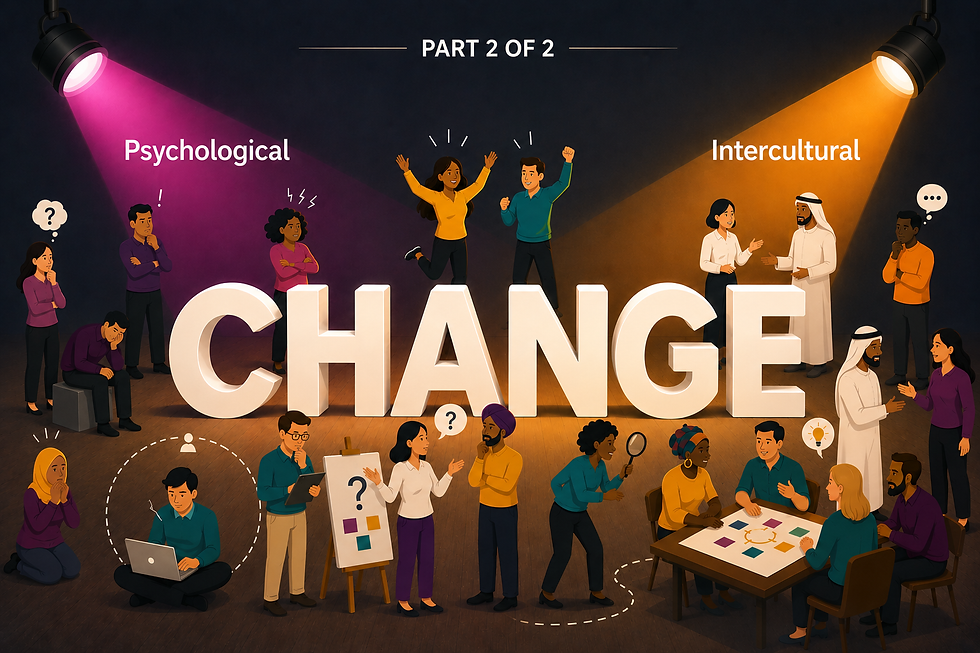
This is the second article in a short series on managers leading the people side of change. The first article focused on the psychological lens and how Everything DiSC Management helps managers understand themselves and their people during change. It is worth reading that article first, because this second lens builds on it.
Everything DiSC helps a manager ask, “Who am I as a psychological human being, and how does that shape the way I lead people through change?” Inter-Cultural Intelligence asks the next question: “Who am I as a cultural human being, and how does that shape the way I understand, communicate, and lead change?”
That question becomes very practical the moment change hits a team. When a new structure, system, strategy, or way of working is introduced, people are not only trying to understand the practical impact. They are also interpreting the meaning of the change. They may be asking whether the decision was made in the right way, whether the right people were consulted, whether the change brings honor or shame to the team, whether the process is fair, whether they are still safe, and whether “our people” have been remembered.
Many of these questions are never spoken directly. They may show up as silence, careful questioning, resistance, side conversations, loss of energy, or a sudden drop in trust. A manager who only looks at behavior may miss the cultural “why” underneath the response.
At KnowledgeWorkx, we often talk about two spotlights. The interpersonal spotlight helps us understand personality-driven behavior. The intercultural spotlight helps us understand culturally driven behavior. Our Two Spotlights article explains that Self-Cultural Analysis treats each person as a unique cultural being and works best alongside personality-driven frameworks because each shines a different light on human behavior.
In change, managers need both. The psychological lens helps them understand how people respond to pressure, conflict, pace, uncertainty, and motivation. The cultural lens helps them understand how people interpret trust, fairness, authority, relationship, communication, accountability, status, and belonging. DDI describes change as both “head and heart” work, and Prosci reminds us that managers become communicators, liaisons, advocates, resistance managers, and coaches during change. Those ideas are helpful, but in interculturally complex environments we need to go one layer deeper: the “heart” side of change is also cultural.
This is where George Kesselaar’s PhD research, discussed in KnowledgeWorkx’s article on leading strategic change with Intercultural Agility, adds significant weight. His work does not focus only on what needs to change, but on how people relate to change. That distinction matters. Many organizations put enormous energy into rollout plans, process maps, communication cascades, and change timelines. Those things are needed, but they do not automatically answer the questions people carry inside: “Does this make sense for me?” “Is this safe?” “Can I trust the people leading this?” “Do I have a place in what is coming?”
George’s research confirms something we have seen many times in interculturally complex teams: behavior is the bridge between culture and change. You cannot build change-supportive behavior if you do not understand what drives behavior. The KnowledgeWorkx article makes this practical by showing how tools such as the Three Colors of Worldview and the 12 Dimensions of Culture help teams see what is otherwise invisible. Why does one team experience directness as clarity while another experiences it as confrontation? Why does one leader feel urgency while another waits for consensus? Those are not just communication preferences. They are cultural meaning systems shaping how people experience change.
For managers, this changes the work of change leadership. It is not enough to deliver the message and then label reactions as support or resistance. Managers need to understand the cultural drivers shaping how people hear the message, evaluate the change, and decide whether they can support it.
The Three Colors of Worldview gives managers a simple way to begin. During change, Honor/Shame may show up when people are concerned about dignity, face, loyalty, reputation, or whether their team has been treated honorably. Innocence/Guilt may show up when people are asking whether the change is right, fair, transparent, and just. Power/Fear may show up when people are watching who gains control, who loses influence, and whether the future feels safe.
A change may be strategically sound, but if it humiliates a respected leader, bypasses important relationships, feels unfair, or creates unnecessary fear, the change may be resisted in ways that are difficult to see on a project plan. The decision may not need to change, but the way the change is communicated, sequenced, explained, and implemented may need to change. A manager who understands Honor/Shame will pay attention to dignity. A manager who understands Innocence/Guilt will pay attention to fairness and transparency. A manager who understands Power/Fear will pay attention to safety, control, and fear reduction.
The Cultural Mapping inventory (CMi) adds another layer. It helps managers understand personal and group cultural preferences and gives neutral language for what often goes unnamed. When a manager prepares a change conversation, the CMi lens helps them think beyond the message itself. Is this team expecting more direct communication or more indirect communication? Should the decision be explained through rules, policies, and logic, or through relationship and stakeholder impact? Is the tension really about the timeline, or is it about people feeling pushed faster than trust allows? Is accountability being understood individually or collectively? Is status attached mainly to achievement, or are title, age, role, and seniority also important in how this message should land?
This is not about making managers hesitant to communicate. It is about helping them communicate with more precision. Self-Cultural Analysis was designed to move us away from nationality and ethnicity as the main starting point and toward personal cultural preferences. KnowledgeWorkx describes the Three Colors of Worldview and the CMi as tools that help us understand cultural motivators and demotivators, analyze intercultural situations, and build more respectful relationships.
This is also where Perception Management tools become very practical. They are not the whole story, but they help managers slow down at the moments where change can easily become distorted. KnowledgeWorkx describes tools such as Perception Builders and Breakers, D.I.R. — Describe, Interpret, Respond — Mirroring, Single Story awareness, and the Cultural Learner/Cultural Critic distinction as ways to slow down, gather more information, and avoid drawing conclusions too quickly.
For a manager, this may look simple. Before announcing a change, D.I.R. helps them separate what they actually know from what they are assuming. In a listening session, mirroring helps them hear meaning before defending the process. If someone says, “People were not consulted,” the manager can pause and reflect, “It sounds like the way the decision was made has affected trust.” That does not mean the manager agrees with every concern. It means they are listening before judging. Under pressure, this discipline matters because stories can move faster than truth.
Single Story awareness is just as important. A manager may form a quick story: “This team always resists change.” Once that story takes hold, the manager stops learning. A Cultural Learner posture asks, “What else could be true here?” Maybe the team has lived through failed change before. Maybe a respected person was bypassed. Maybe the message created fear. Maybe the team is protecting customers, relationships, or quality. KnowledgeWorkx describes Cultural Learners as people who rely less on natural biases, ask questions to understand behavior, and keep growing in cultural awareness and agility.
This is where Inter-Cultural Intelligence can reduce productivity loss. Less energy is wasted in misinterpretation. Communication becomes more resonant. Trust can be repaired earlier. Team cohesion improves because people feel seen more accurately. Team culture becomes healthier because difference can be discussed with neutral language instead of blame. KnowledgeWorkx’s Self-Cultural Analysis article says that applying these methods with teams has helped reduce tensions and miscommunications so teams can spend more time working on their actual purpose.
George’s research gives further weight to this (Listen to podcast episode that unpacks this further). Identical change strategies can create different levels of engagement depending on worldview alignment. Change done interculturally may feel slower at the beginning, but it builds the relational infrastructure that allows people to go further together.
This is the KnowledgeWorkx contribution to managers leading change. Everything DiSC Management helps managers understand the psychological “why” behind behavior. Inter-Cultural Intelligence helps them understand the cultural “why” behind meaning. Together, the two spotlights help managers meet people where they are, communicate with greater accuracy, and build a team culture that can move through change without unnecessary relational damage.
In practice, this becomes a modular, need-driven development journey. Some organizations may need to begin with the psychological lens, using Everything DiSC Management or Worksmart on Catalyst to help managers understand their own management style and the behavioral needs of their people during change. Other organizations, especially those operating across cultures, regions, functions, or stakeholder groups, may need to begin with the cultural lens, using the Three Colors of Worldview, the CMi, and Perception Management tools to understand the cultural meaning people attach to change. Each lens deserves enough space to become practical. Over time, the strongest pathway brings both lenses together.
Change is not only psychological. It is cultural. Managers who understand both are better equipped to lead the people side of change in the complex markets and teams we are all living in now.
Start a conversation with us to equip your managers to navigate change
Over the last 20 years, KnowledgeWorkx has developed solutions that are global, locally relevant, holistic, and practical. Our innovative approach delivers more accurate analysis, which results in integrated and more effective solutions. Our solutions create a progressive and natural connection between national, personal, team, and organizational culture.

This work is licensed under a Creative Commons Attribution-NonCommercial-NoDerivatives 4.0 International License.