The Work of Leaders in Intercultural Leadership Teams
Updated: Aug 3
Part 1 of 2

Why Vision, Alignment, and Execution Give Leadership Teams a Practical Language
There are thousands of books on leadership. Some are helpful. Some are inspiring. But after another book, another talk, or another leadership conference, many teams still ask the same question:
What do we actually do differently on Monday morning?
That is one reason I have found the Everything DiSC Work of Leaders framework so helpful. It is simple, but not simplistic. It has enough depth to support personal growth, improve one-on-one leadership, and shape team culture in very practical ways.
Leadership teams often do not lack effort; they lack a shared language for the real work of leadership.
Over the years, I have had the privilege of using it in executive coaching, in leadership team development, and with managers who are beginning to step into more leadership responsibility. That last group is important. Today, many managers are not only managing resources, processes, and tasks. They are expected to contribute to strategy, influence across the organization, and lead change. To make that a reality they need to start thinking at a more strategic level.
That is what Work of Leaders does beautifully.
It asks a simple question: what do leaders do?
The answer is clear: leaders craft vision, build alignment, and champion execution.
I have found that to be true across cultures. Even when the larger strategy is handed down from above, the leader still has work to do. A country leader or regional leader may receive a strategy from headquarters. But they still need to craft vision for their geography, department, or team. They still need to build alignment around that vision. And they still need to champion execution.
A strategy handed down from above still needs to become a lived vision in a specific geography, department, and team.
One of the reasons I appreciate this framework is that it is not another competency model. Most organizations already have one of those. In my experience, Work of Leaders fits almost any leadership competency framework because it is a behavioral framework. It helps leaders look at how they show up when they are doing the work of leadership.
Actually, I would go one step further. These behaviors are also mindsets and disciplines.
That becomes very helpful when a leadership team begins asking:
How do we become a better strategic leadership team?
How do I become a better contributor to this leadership team?
How do we stop reacting and start leading more intentionally?

I remember one regional leadership team that came to us. They were successful. The numbers were good. From the outside, there was nothing obviously wrong.
But they were frustrated, they were tired. And they wanted to explore what it would mean to reach the next level.
The issue is not always leadership capability. Very often, it is how leaders experience and interpret each other’s leadership behaviors.
Very quickly, we realized there were different behavioral styles on the team. When we talked about meetings, decision-making, risk, communication, and navigating differences, it became clear that they thought very differently about leadership.
One person would ask critical questions about consequences and risk. In their mind, that was responsible leadership. They were helping the team slow down and think clearly. Another person experienced the same behavior very differently. To them, it felt like, “You are holding us back. Why are you not more adventurous?”
That is not simply a personality issue. It is about how a person shows up as a leader with their behavioral style.
In one workshop, this showed up around Crafting Vision. The leader could clearly see the future. He spoke with energy about where the organization needed to go and the possibilities ahead. But when the managers and staff began to respond, something shifted. Their questions were meant to understand, connect and engage with the vision. Yet in the moment, some of those questions felt more like a challenge. So instead of creating more room for dialogue, the conversation started to move toward explanation and defense. As we slowed it down, the team began to see that questions are often not resistance. They can be people’s way of stepping into the vision.
Work of Leaders brings those things to the surface in a practical way.
It is not about saying everybody needs perfect leadership behaviors. That would not be realistic. It is about helping each leader see what they naturally bring to the table, what they do well, and where they may need to stretch.
From there, the question becomes practical:
Who do I need to become to be a better contributor to this leadership team?
The individual reports are helpful for that. They help people understand their own leadership tendencies. They also help people talk one-to-one with significant colleagues:
This is how I show up.
This is how you show up.
This is where we complement each other.
This is where we may frustrate each other.
The group report takes the conversation to another level.
I often describe the group report as a bench-strength analysis for the leadership team. It helps the team see what comes naturally to them as a group and where the collective gaps are.
A group report is not a scorecard. It is a mirror that helps a leadership team see where flow is natural and where friction is being created.
Most teams do certain leadership disciplines quite well. But there are usually other disciplines that are growth areas for the team. They struggle with them, and often they do not realize it.
What often comes to the surface are two or three behavior growth areas. These are the behaviors that do not come naturally to the team as a whole.
When that happens, I ask the team to look back over the last year.
Which projects went well?
Which projects did not go well?
Which initiatives started with energy but lost momentum?
Very often, the group report explains why.
Take feedback, for instance, under championing execution. Feedback has two sides.
One side is problem-related feedback. Something is not working. Something is not going the way we expected. Leaders need listening mechanisms. They need ways to harvest feedback and notice what is really happening.
The other side is affirmation and praise. People need to hear, “That was a fantastic initiative,” or “Well done,” or “Thank you for pushing this forward.”
I have seen leadership teams that do not naturally do either side well. It is almost as if they say, “We built the strategy. We aligned the resources. We launched the initiative. Now we can move on.”
But then issues go unnoticed. Or they continue too long and become bigger issues. At the same time, people do not receive the encouragement that helps them keep going.
Once a team sees that gap, they can start stretching into it.
The same thing happens with building alignment. I have seen teams meet, walk away, and then ask, “What did we actually decide?” Often this happens because people are more intuitive and impromptu in how they speak. They do not listen to each other well enough. Clarity becomes vague and dialogue doesn’t have depth.
One of my earliest mentors from Singapore, Mr. Khoo, taught me the “Cascading Water Principle”. In nature when water runs down the mountain it becomes cleaner (if there is no human interference). But in business: when there is messiness at the top, it becomes even messier for the people reporting to them and the people reporting to them etc.
When there is messiness at the top, it multiplies as it moves through the organization.
For the regional team I mentioned earlier, Work of Leaders gave them the language they needed to talk about difference. It also normalized that no leader in the world is naturally good at all the 18 disciplines in the Work of Leaders framework. It shows beautifully how leaders need each other! They began to see how each leader showed up differently. The conversation became more relaxed. There was laughter. People could say, “Ah, that explains so much. You show up this way. I show up that way.”
But then came the next question:
Now that we understand this, what does it mean practically for how we collaborate?
That is where the real work begins.
Over time, I have seen the tool work at three levels: first in the leader’s own development, then in one-to-one conversations between colleagues, and finally in the leadership team as a whole.
But there is another layer.
Work of Leaders gives a strong language for leadership practices and disciplines. It helps us understand how we lead as psychological human beings.
But when we work with intercultural leadership teams, another question always comes up:
How do we do this across cultures?
I may discover that I tend to present information rather than exchange perspectives.
I may learn that I need to be more open to dialogue.
But how do I do that interculturally?
Exchanging perspectives in a highly hierarchical culture will look very different from exchanging perspectives in a more egalitarian, consensus-based culture.
That is the second layer.
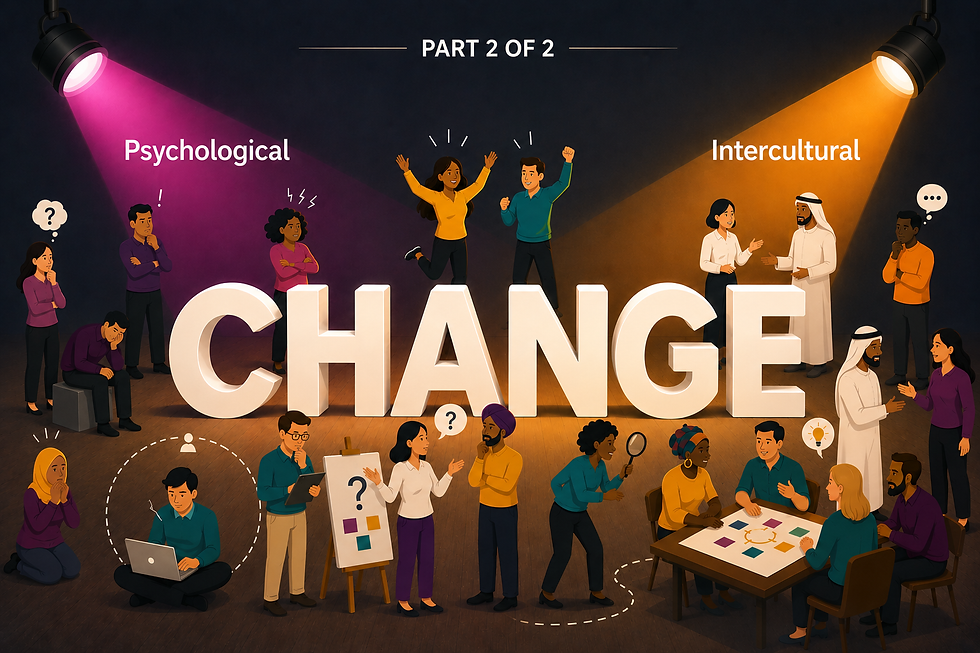
In the next article, I want to explore how we bring intercultural tools alongside the Work of Leaders. Because leaders need to understand both: who am I as a psychological human being, and who am I as a cultural human being?
Over the last 20 years, KnowledgeWorkx has developed solutions that are global, locally relevant, holistic, and practical. Our innovative approach delivers more accurate analysis, which results in integrated and more effective solutions. Our solutions create a progressive and natural connection between national, personal, team, and organizational culture.

This work is licensed under a Creative Commons Attribution-NonCommercial-NoDerivatives 4.0 International License.