When Leadership Behaviors Travel Across Cultures
Updated: Aug 3
Part 2 of 2

The Work of Leaders in Intercultural Leadership Teams
In the first article, I introduced the Work of Leaders profile and the way we have used it with leadership teams.
It creates awareness. It gives leaders language to talk about that awareness. Then it helps them ask: What are the consequences for me, and what are the consequences for us? And lastly: It creates clear pathways for individual and team growth as well as activating the leadership team culture.
But we realized quickly that there is another layer.
The Work of Leaders report tells us what leadership behaviors matter. But in intercultural leadership teams, the next question is always, “How do we actually do these things across cultures?”
Leadership behavior does not travel across cultures unchanged; it is interpreted through the cultural lenses of the people receiving it.
Take an example from championing execution. The framework asks whether a leader is more naturally oriented toward maintaining harmony or addressing problems.
At first glance, that looks like a behavioral style issue. But it is at the same time also a cultural issue.
Some cultures are more harmony-oriented. People may be very careful about how problems are addressed. They may avoid direct confrontation and work hard to protect the relationship (Relationship-centric Resolution).
Other cultures are more pragmatic. People may separate the relationship from the issue. They can have a strong discussion about the problem and then go for coffee afterwards as if nothing happened (Problem-centric Resolution).
An outsider might think, “Don’t these people like each other?” But from inside that cultural setting, they are simply solving the problem.
So, the question then becomes: how can a leader address problems in a way that is both effective and culturally wise?
Another example is receptivity.
In the Work of Leaders framework, being receptive is important in building alignment. But what does receptivity look like across hierarchy?
What looks like clear leadership in one culture may feel confusing, weak, or even disrespectful in another.
In more formal or hierarchical cultures, people may expect leaders to give direction, have answers ready and people might be waiting for the leader to speak first. If a senior leader asks for too many opinions, or opens the floor without sharing their opinion first, it might be perceived as weakness by some people.
So, when a leader says, “I need to become more receptive,” the intercultural question is not only, “Am I willing to listen?” The deeper question is, “How do I listen in a way that is culturally resonant?”
The question is not only, “Am I willing to listen?” The deeper question is, “How do I listen in a way that is culturally resonant?”
We navigated this in a leadership team responsible for a large geographic area with about 14,000 people involved. We worked with that team for multiple years. We started with the Work of Leaders profile.
But as we continued, the leaders asked more practical questions. How do I become more receptive and still have people respect my seniority? How do I explore implications while still being seen as decisive? How do I harvest people’s ideas and reservations without creating confusion?
Those are behavioral questions and they are also cultural questions.
This became even more important when the team wanted to cascade the work to managers across nine countries. This ambition raised many intercultural questions. We realized we need the KnowledgeWorkx Three Colors of Worldview to scaffold the conversations and practices with intercultural depth and insights.
Take encouragement as an example.
In the Work of Leaders framework, leaders may reflect on whether they are more matter-of-fact or more encouraging. But how is encouragement perceived across cultures?
If somebody did something well, do you just say, “You did X, Y, and Z really well”?
Maybe.
But even then, how do you do it? Do you say it publicly or privately? Do you say it in the meeting, or do you come back to it later? Do you say it directly or indirectly?
Only looking at this from a right-and-wrong (what we call in Three Colors of Worldview language: “Innocence <> Guilt”) perspective is not enough.
The Three Colors of Worldview helped the team ask better questions.
What is the right thing to do?
What is the most honorable thing to do?
What would be received as empowering or life-giving by the person on the other end?
Some leaders on the team were very Innocence/Guilt oriented. They focused on what was right or wrong. But many of the staff in the organization were more Power/Fear oriented, where hierarchy mattered deeply, or more Honor/Shame oriented, where harmony and saving face were very important.
That changed the conversation.
As a result of bringing in the Three Colors of Worldview they had more tools in their leadership toolbox! They could ask: How do we do the right thing? How do we do right by the people involved? How do we address the issue in an honorable way? How do we avoid calling people out publicly and causing unnecessary shame? How do we give people a chance to quietly fix situations, draw on their expertise and be empowering and life-giving?
All of a sudden, they had a culturally more nuanced way of addressing problems while still being mindful of harmony.
The Work of Leaders gave them language to talk about leadership practices and leadership disciplines. Three Colors of Worldview gave them language to ask, “How do I fine-tune my approach with this particular individual or group of people?”
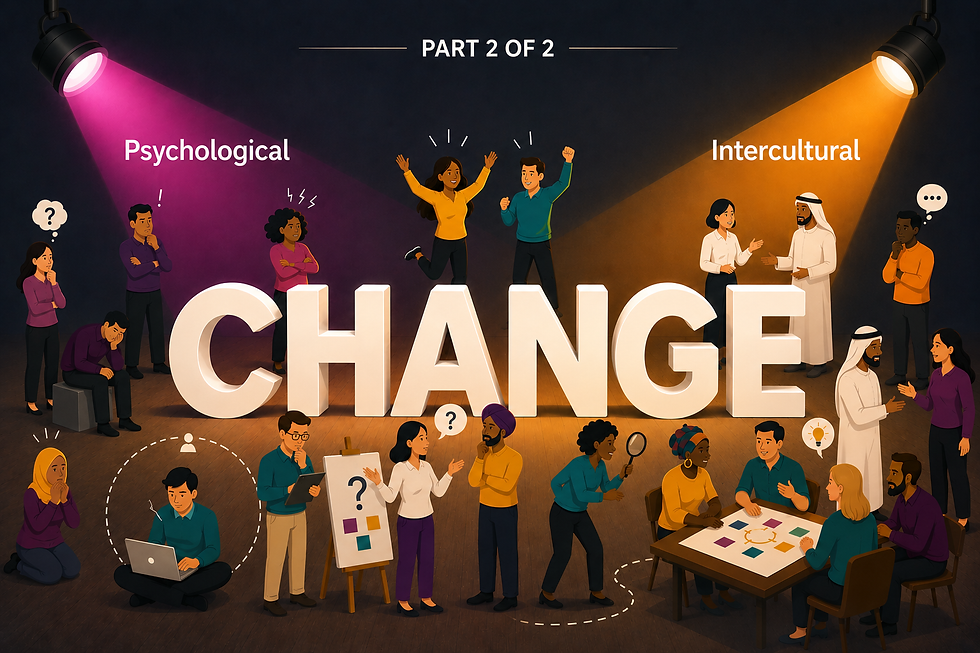
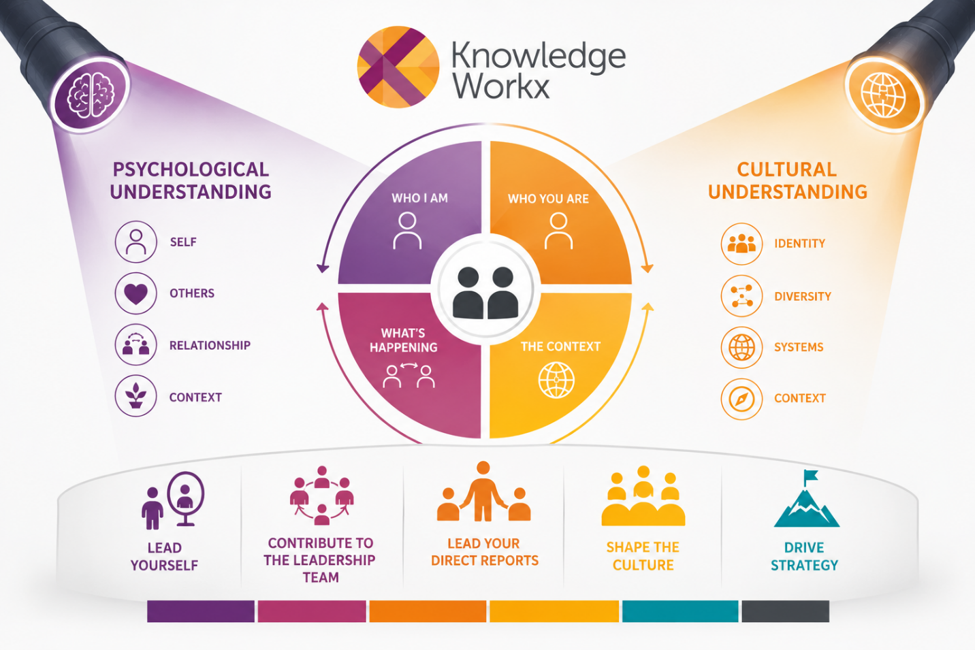
They had a psychological lens through Everything DiSC Work of Leaders and a cultural lens through Three Colors of Worldview and the 12 Dimensions of Culture. We call this the “Two Spotlights Approach”. It is empowering to be able to illuminate both the psychological and cultural sides of any situation!
But then we discovered something else.
When the pressure was on, leaders often went into default mode.
You may be familiar with the idea that our brain forms patterns over time. From the time we are young, we learn patterns for handling conflict, receiving praise, making decisions, leading, and following.
Those patterns become our Default Mode Network (DMN).
With the team I mentioned earlier, we saw that increased pressure led to going back to default old patterns. For example, a leader from a strong Innocence/Guilt orientation might go back to separating the relationship from the problem. In their mind, they are simply fixing the problem quickly because that is what needs to be done.
They may solve the technical issue and create a cultural or relational issue at the same time.
A leader can solve the technical issue and create a relational issue at the same time.
It was fascinating to listen to their stories from across Asia. They shared projects and initiatives that were very successful while other projects had only worked partially or had failed. We then started using the Perception Management tools to ‘slow things down’ and ask intercultural questions that drilled into the “why of the why” of success or failure.
This time of slowing down became very important because it illuminated their lived experience as leaders in a new way and revealed more lessons to learn.
At KnowledgeWorkx, we use perception management tools to help leaders slow down. One simple way is to ask four questions:
Who am I in this moment?
Who are you in this moment?
What is relationally trying to happen between us?
What is the context of this conversation?
Context may include role, hierarchy, the project, what is at stake, and who else is involved. These questions help leaders avoid running with their Default Mode Network only and become more intentional. Using the 5 Perception Management tools allows leaders to see more, hear more and gather more valuable insights and data points.
For instance, some leaders may say, “We need to seek counsel. We need to ask more opinions.” Others may say, “No, we need to decide and move forward.”
Both can be valid.
But if we slow down and ask, “What is culturally expected from us?” we may realize that seeking counsel is important, even if it does not change the final decision. Politically and relationally, it may matter. It may honor people’s expertise or role. It may also turn them into allies when execution begins.
One of the KnowledgeWorkx Perception Management tools is the Cultural Learner Mindset Tool.
Under pressure, it is easy to become a Cultural Critic. We judge quickly. We assume too much. But bringing a Cultural Learner Mindset into the situation causes us to slow down, ask better questions and pay attention more. How do I structure my messaging in this cultural setting? How do I explain the rationale in a way people will understand? Should I do this alone, or collaborate with someone who is trusted in that community?
The Cultural Learner Mindset helps leaders create better connection, better engagement, and better outcomes.
As we worked with this team, we kept moving between two lenses.
Sometimes we needed the psychological lens: who am I as a psychological human being?
At other times we needed the cultural lens: who am I as a cultural human being?
Both lenses are powerful. And for global teams, both are needed.
Global leaders need two lenses: the psychological lens to understand how they lead, and the cultural lens to understand how their leadership is received.
In organizations with high cultural complexity, only having a psychological lens is not enough. But only having a cultural lens is also not enough.
Leaders need both.
When leadership teams learn to use both lenses, they can reach new levels of productivity and performance. But it is not only about performance. Work becomes more enjoyable, and leaders handle complexity with more confidence. They thrive as individuals and teams and perform at a higher level together.
Over the last 20 years, KnowledgeWorkx has developed solutions that are global, locally relevant, holistic, and practical. Our innovative approach delivers more accurate analysis, which results in integrated and more effective solutions. Our solutions create a progressive and natural connection between national, personal, team, and organizational culture.

This work is licensed under a Creative Commons Attribution-NonCommercial-NoDerivatives 4.0 International License.